Turkish Get-Up: How to Do It Step by Step, From Master Phil Ross
The Turkish get-up takes you from the floor to standing with a kettlebell overhead. Here are the six positions, step by step, with Master Phil Ross's cues and videos.
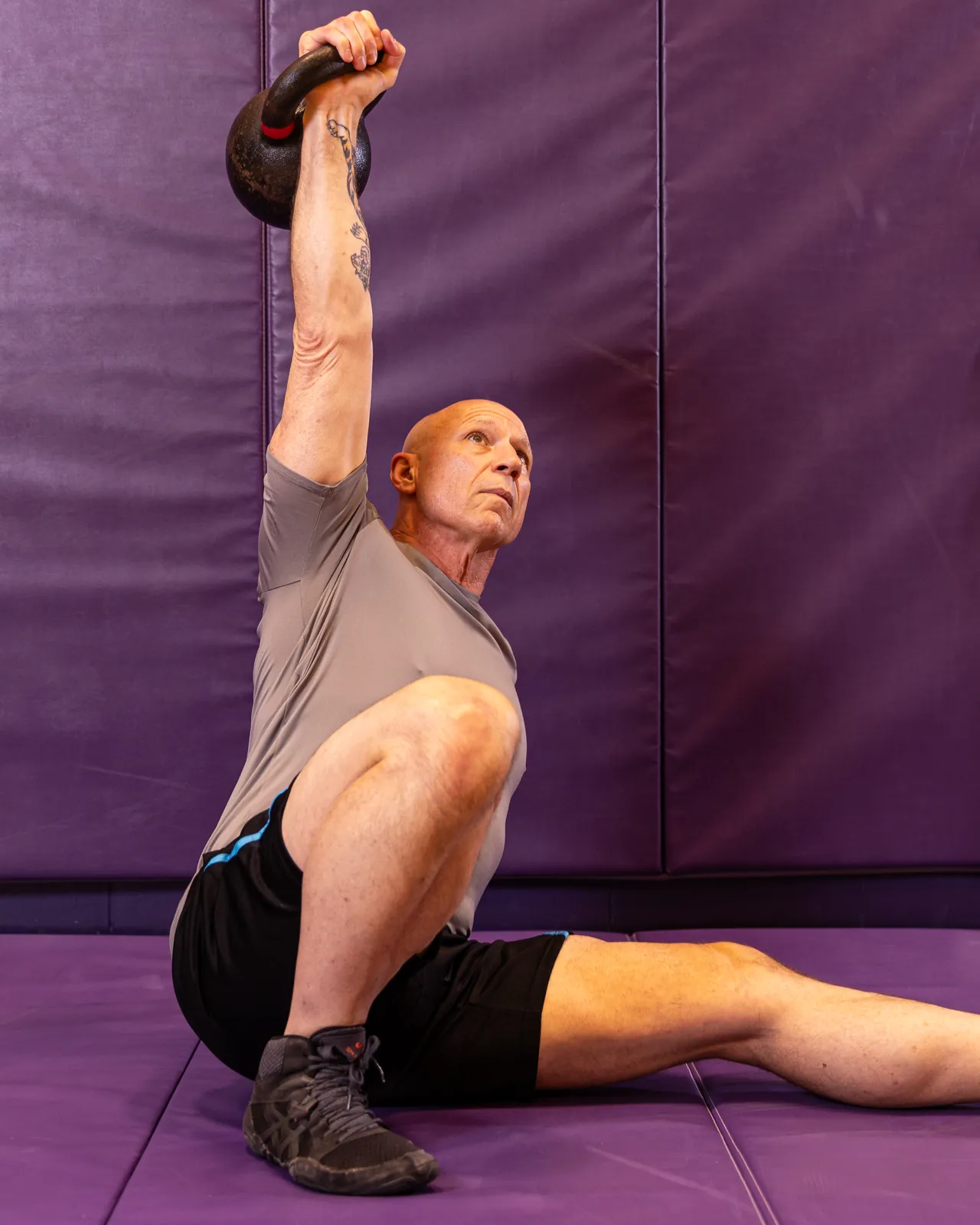
The Turkish get-up is a kettlebell exercise where you start lying on the floor with the bell pressed overhead, stand all the way up while keeping it locked out, and then reverse the steps back to the floor. One repetition combines a press, a hip hinge and a lunge, and it moves your body through every level from lying to standing.
Master Phil Ross, a Master RKC kettlebell instructor and the creator of the BodyBell Method®, calls the get-up perhaps the most complete kettlebell movement there is. This guide covers what the get-up trains, the six positions step by step, the cues Phil uses when he teaches it, and his videos so you can follow along.
What is a Turkish get-up?
The Turkish get-up, often shortened to TGU or simply "the get-up," is a slow, controlled lift. You hold one kettlebell in one hand with the arm straight and the wrist, elbow and shoulder locked in line. Keeping the bell over your shoulder the whole time, you roll to your elbow, sit up, sweep a leg under you, kneel and stand. Then you return to the floor the same way.
Phil describes it as a hybrid. It is not a pure strength lift, a pure mobility drill or a pure hip hinge. It has parts of all three, which is why it shows up in hardstyle kettlebell programs for athletes, fighters and everyday trainees alike.
Benefits of the Turkish get-up
- Shoulder stability. The shoulder holding the bell has to stay packed and steady through every change of position.
- Strength and mobility together. The get-up includes a press, a hip hinge and a lunge, so it trains strength through a full range of motion instead of in one fixed position.
- Rotation and coordination. Phil points out that the get-up moves through the transverse plane, the plane of rotation. That makes it useful for sports with twisting and turning, including combat sports.
- Getting up off the floor. The movement practices the same skill you use every time you get down to the ground and back up again.
Research supports the shoulder benefit. In a 2019 study in the Journal of Bodywork and Movement Therapies, researchers measured eight shoulder muscle groups on both sides of the body in 12 experienced adults while they performed the get-up. The stages from the press to the elbow and the leg sweep placed the greatest demand on the shoulder muscles. Muscles on the non-bell side also worked whenever that arm helped support the body. The authors recommended training both the way up and the way down to get the most benefit.
How to do a Turkish get-up: the six positions
Phil teaches the get-up as six positions, and he says you need to own each one. Move slowly and pause in every position before moving to the next. The steps below describe the bell in the right hand. Switch sides for the left.
Set up: get the bell into position safely
Lie on your right side in a fetal position with the kettlebell close to your chest. Thread your right hand through the handle, place your left hand over it, and keep the bell tight to your body as you roll onto your back. Getting the bell into position with two hands protects your shoulder before the lift even starts.
- Press. Press the bell up with both hands, then take the left hand away. Your knuckles face the ceiling, your wrist is straight, your elbow is locked and your shoulder is packed down. Bend your right knee and plant that heel as close to your butt as you can. Spread your feet apart, with the left leg straight on the floor. Place your left arm on the floor at about a 45 degree angle and "karate chop" the floor with it to create tension through your upper back.
- Elbow post. Drive through your right foot and roll up onto your left elbow. Make your chest as big as you can. Your right knee will want to collapse inward, so keep pushing it out. Keep the bell in your line of sight.
- Tall sit. Push up from your elbow onto your left palm so you are sitting tall. Your right foot should still be close to your butt, and the bell stays in the edge of your vision.
- Leg sweep. Lift your hips and swing your left leg back underneath you so you are kneeling on your left knee. Phil describes this as making an L on the floor with your hand, your knee, your foot and your other foot. Plant your toes on the floor, not the top of your foot. This is where the hip hinge comes in.
- Tall kneel. Lift your hand off the floor and bring your torso upright. Pivot your back foot like a windshield wiper so your hips and shoulders square up. If you need to adjust your stance, that is fine.
- Stand. Load your front foot, push with your back foot and stand up tall with the bell locked out overhead. Wrist straight, elbow locked, shoulder packed.
The way back down
Reverse the six positions. Phil taps the leg he is going to step back with so he does not get confused. Step back into a lunge and lower your knee to the floor. Windshield wiper your back foot, hip hinge, and slide your left hand down your leg to the floor. Post on your hand and foot, swing your left leg through to the tall sit, lower to your elbow, and roll back to your shoulder. Bring your left hand back to the bell, lower it to your chest with both hands, and roll to your side to set it down.
The five-second hold drill
Phil's reminder is that the get-up is not meant to be done fast. To help you own every position, he uses a drill where you pause and hold each position for a count of five on the way up and on the way down. It adds a lot of time under tension and shows you right away which position needs work.
Common Turkish get-up mistakes
- Bent wrist or soft elbow. Keep the wrist straight and the elbow locked so the bell stacks over the shoulder.
- Shrugged shoulder. Keep the shoulder packed down and away from your ear.
- Rushing. Moving fast makes it easy to skip past a weak position. Slow down and pause in each one.
- Planted foot too far away. Keep the heel close to your butt so you can drive up to the elbow.
- Collapsing knee. Push the bent knee out as you roll to the elbow.
- Losing track of the bell. Keep it in sight, or at least in the edge of your vision, the whole time.
- Setting the bell down one-handed. Use two hands and roll to your side to lower it, just as you did to pick it up.
How heavy should your kettlebell be?
Learn the six positions with no weight or a very light kettlebell first. Add weight only when you can pause in every position, on the way up and the way down, without your wrist bending or your shoulder shrugging. Because the get-up is slow and technical, low repetitions on each side are common. Focus on clean positions rather than a high number of reps.
Turkish get-up variations
Once the basic get-up is solid, Phil's videos show harder versions:
- Bottoms-up get-up. The kettlebell is held upside down, with the bottom of the bell pointing at the ceiling. It demands a strong grip and a very steady shoulder.
- Double kettlebell get-up. One bell in each hand, both locked out overhead. Phil describes it as a little more difficult than the single-bell version.
Phil also shows a few ways to switch the bell from one side to the other between repetitions, such as passing it around your head or turning your body to the other side.
Is the Turkish get-up safe?
For most healthy adults it is, as long as you start light, move slowly and keep the bell under control. Check with your doctor or physical therapist first if you have a shoulder injury, shoulder pain, a recent injury or a condition that affects your balance. Stop if you feel sharp pain, and lower the bell with two hands if you lose control of the position.
How the get-up fits the BodyBell Method
The BodyBell Method combines kettlebells, calisthenics and dynamic tension, and the get-up is one of the core kettlebell lifts in Phil's Kettlebell Basics manual. It ties the three together: you lift a kettlebell, you move your own body from the floor to standing, and you hold full-body tension the whole way. If you want a no-equipment way to practice that kind of tension, read our guide to dynamic tension exercises.
If you are a trainer, coach or physical therapist, the BodyBell Method certification teaches you to coach the get-up and the other core lifts, and the online kettlebell certification covers the method one-on-one in eight virtual sessions. If you are over 50, read our guide to kettlebell training after 50. More of Phil's technique videos are on his YouTube channel.
Frequently asked questions
What is a Turkish get-up?
It is a kettlebell exercise where you stand up from lying on your back while holding a kettlebell locked out overhead in one hand, then return to the floor. It combines a press, a hip hinge and a lunge.
What muscles does the Turkish get-up work?
It works the shoulders, upper back, core, hips and legs. Research shows the shoulder muscles on the bell side work hardest during the press to the elbow and the leg sweep, and the muscles on the other side work whenever that arm supports your body.
What are the six positions of the Turkish get-up?
Press, elbow post, tall sit, leg sweep, tall kneel and stand. You then reverse them to return to the floor.
How many reps of Turkish get-ups should I do?
Keep the reps low and the pace slow. A few careful repetitions on each side, with a pause in every position, are better than many fast ones.
Is the Turkish get-up good for older adults?
It can be, because it practices getting down to the floor and back up, which matters for everyday life. Start with no weight or a very light bell, move slowly, and check with your doctor first if you have a shoulder problem or balance concerns.
References
- St-Onge, E., Robb, A., Beach, T. A. C., & Howarth, S. J. (2019). A descriptive analysis of shoulder muscle activities during individual stages of the Turkish Get-Up exercise. Journal of Bodywork and Movement Therapies, 23(1), 23-31. https://doi.org/10.1016/j.jbmt.2018.01.013
- Master Phil Ross. Turkish Get up by Master RKC Phil Ross. YouTube. youtube.com/watch?v=UJ6Z6OqXM-I
- Master Phil Ross. Kettlebells: Turkish Get-up with 5 Second Hold. YouTube. youtube.com/watch?v=VFLBmGc7D5A
- Master Phil Ross. Dirty Dozen Move #9: The Get Up. YouTube. youtube.com/watch?v=ZtX6YYy1O4o
- Master Phil Ross. Kettlebells for Combat Athletes: Turkish Get-Up. YouTube. youtube.com/watch?v=RTkfnc0PzY0
More from the journal.
Get certified.
Teach kettlebell training, bodyweight exercises and dynamic tension with the BodyBell Method. The certification is approved for continuing education credits by NASM, ACE and AFAA.