Movement After 50: Why the Right Fitness Test Matters
The best fitness test after 50 is not the fanciest one. It is the one that tells you whether your training is helping you live better, stay balanced, and avoid falls.
Article summary
The source article in Forum_1.doc focused on a key idea from motor learning: movement matters, but how we measure movement matters just as much. The original post explained that human movement helps us survive, perform, teach, learn, and adapt. It then introduced two essential testing concepts: reliability and validity.
Reliability means a test can be repeated in a consistent way. If you measure your balance today and then measure it again next week, the process should be similar enough that the comparison means something. Validity means the test actually measures what you care about. A standing long-jump test may tell you something useful about explosive leg power, but it will not tell you much about your ability to safely carry laundry upstairs, get off the floor, or react when you trip on a curb.
The original post used martial arts as a powerful example. A form or kata can be practiced in a repeatable environment, but performance can change when stress, speed, fatigue, or competition enters the picture. That idea applies directly to adults over 50. The way you move in a quiet gym may not be the same way you move when you are tired, rushed, carrying groceries, walking on uneven ground, or reacting to a stumble.
Expert analysis for adults over 50
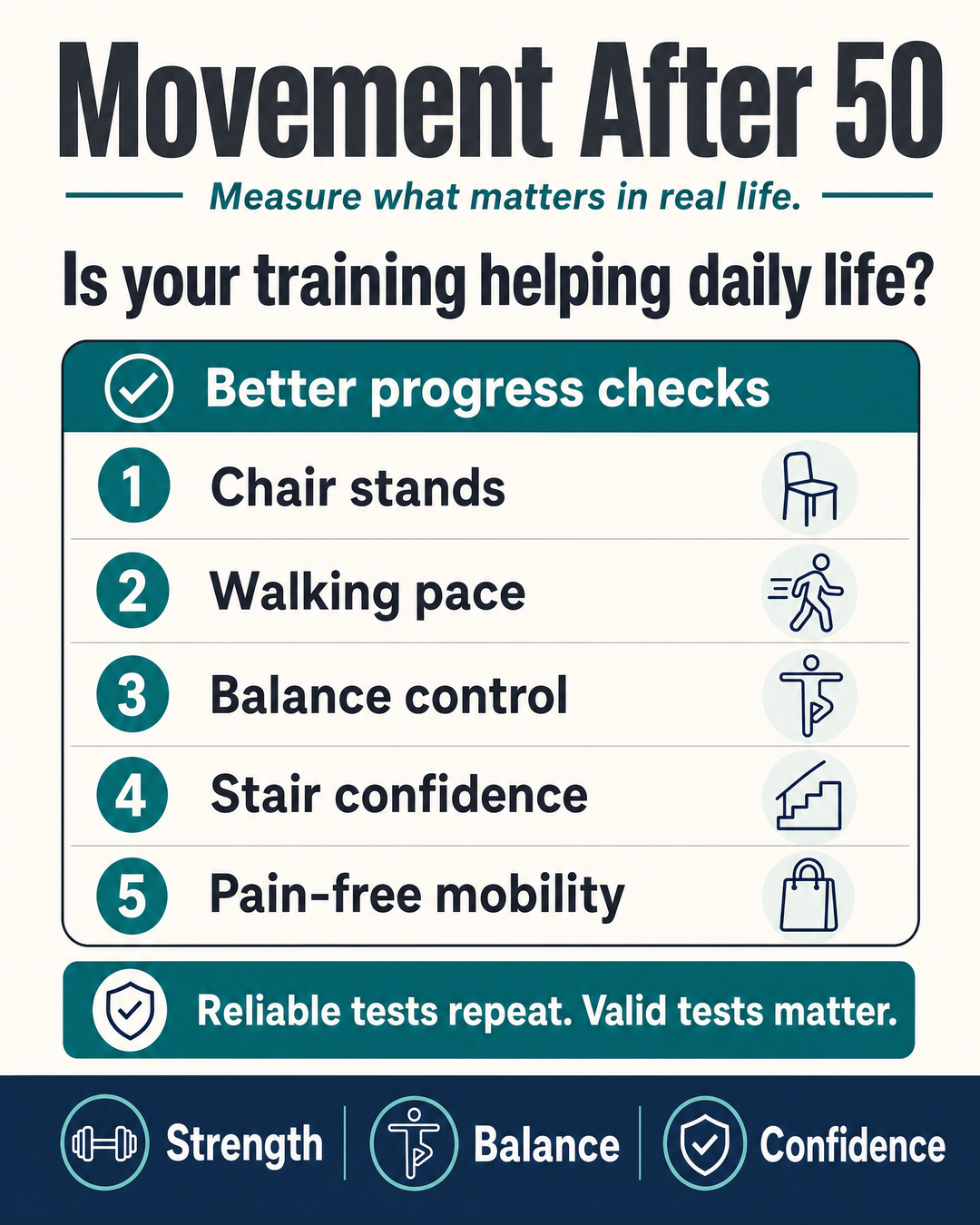
After 50, the best fitness test is not always the fanciest one. It is the one that tells you whether your training is helping you live better. Can you stand from a chair without using your hands? Can you walk briskly without losing posture? Can you climb stairs without knee pain taking over? Can you carry something on one side without leaning? Can you turn your head while walking and still feel steady?
Those are not small questions. They are independence questions.
This is where reliability and validity become practical. A reliable test gives you a repeatable snapshot. A valid test connects that snapshot to real life. If you are over 50, your progress tracking should include measures that reflect strength, balance, walking ability, mobility, endurance, and confidence.
The CDC recommends that adults 65 and older include aerobic activity, muscle-strengthening activity, and balance work every week. The weekly target is at least 150 minutes of moderate-intensity aerobic activity, at least 2 days of muscle-strengthening activity, and balance activities such as heel-to-toe walking or standing from a seated position.[1] That combination matters because aging well is not one quality. It is a blend of heart health, muscle, coordination, joint control, and confidence.
Why vanity metrics are not enough
Weight, body-fat percentage, and calories burned can be useful, but they do not tell the whole story. A person can lose weight and still move poorly. A person can burn calories and still lack balance. A person can lift a heavy weight once and still struggle to control the body during daily life.
For the 50+ population, a better question is this: Is your training transferring to the life you actually live?
If the goal is to reduce fall risk, then balance and reaction training matter. If the goal is to keep playing golf or pickleball, then rotation, hip mobility, footwork, and trunk control matter. If the goal is to travel comfortably, then walking capacity, stair strength, and the ability to lift luggage matter. If the goal is to reduce pain, then movement quality, pacing, and progressive loading matter.
The CDC reports that physical activity can reduce the risk of heart disease, stroke, type 2 diabetes, depression, dementia, several cancers, unhealthy weight gain, weak bones, and falls.[2] Those benefits are broad because movement influences the whole person.
Supporting statistics and research
Falls are one of the clearest examples of why meaningful movement testing matters. The CDC reports that falls are the leading cause of injury for adults aged 65 and older. More than 14 million, or 1 in 4, older adults report falling each year.[3]
The same CDC source reports that about 37 percent of older adults who fall report an injury requiring medical treatment or restricted activity for at least one day, resulting in an estimated 9 million fall injuries.[3] That is not just a statistic. It is a warning that balance, strength, and confidence must be trained before a crisis happens.
Physical activity also provides immediate benefits. The CDC notes that a single session of moderate-to-vigorous activity can improve sleep quality, reduce anxiety, and reduce blood pressure.[2] For adults over 50, this means a workout does not need to be extreme to be valuable. It needs to be appropriate, repeatable, and connected to long-term function.
Practical advice if you have pain, stiffness, or limited mobility
Start with tests that are safe and relevant. A chair stand can tell you about leg strength and daily function. A timed walk can tell you about endurance and gait. A supported single-leg balance hold can tell you about stability. A simple shoulder reach can reveal mobility limits. A step-up to a low platform can show whether the hips, knees, and ankles are sharing the work.
Do not turn testing into punishment. Testing should guide training, not embarrass you. If a test causes pain, modify it. If balance work feels risky, do it near a wall, counter, railing, or stable chair. If walking speed is limited by knee or hip pain, begin with distance tolerance, surface choice, footwear, and recovery time before pushing pace.
Track what matters. Record how many chair stands you can perform with good control. Note whether you used your hands. Time a comfortable walk and a brisk walk. Write down whether pain increased, stayed the same, or improved afterward. These details create a map. Without them, you are guessing.
If you have joint replacement history, dizziness, neuropathy, osteoporosis, recent falls, chest pain, or uncontrolled blood pressure, get medical guidance before pushing intensity or balance challenges. Smart training is not about ignoring red flags. It is about respecting them and still finding a path forward.
A simple movement check for real life
Once per month, choose a few repeatable checks. Try a 30-second chair stand, a comfortable 6-minute walk or shorter walking route, a supported balance hold, a light carry, and a mobility screen for hips and shoulders. Keep the setup the same each time. Use the same chair, same shoes, same walking route, same time of day when possible, and the same scoring method.
Then ask the most important question: Did the result improve in a way that helps my life?
If your chair stand improves, stairs may feel easier. If your walking distance improves, travel may feel less intimidating. If balance improves, uneven ground may feel less threatening. If your shoulder mobility improves, dressing, reaching, and lifting may become easier.
The coaching message
The right fitness test after 50 is not about proving how young you are. It is about learning how your body moves today so you can train it better tomorrow. Reliable tests give you consistency. Valid tests give you meaning. Together, they turn exercise into a plan.
If you want to move better, reduce fear, and build strength that transfers into real life, start measuring what matters. Then train with purpose.
Ready to move with more confidence after 50? Visit the website for coaching, workshops, and practical fitness guidance built for real adults who want strength, longevity, and independence.
References
[1] CDC, Older Adult Activity: An Overview
More from the journal.
Get certified.
Teach kettlebell training, bodyweight exercises and dynamic tension with the BodyBell Method. The certification is approved for continuing education credits by NASM, ACE and AFAA.