The Leucine Trigger: Why More Is Not Always Better for Muscle Growth
Leucine flips the switch on muscle protein synthesis, but research shows a strict biological ceiling. Here's the optimal dose, plus the joint health stack that actually works.
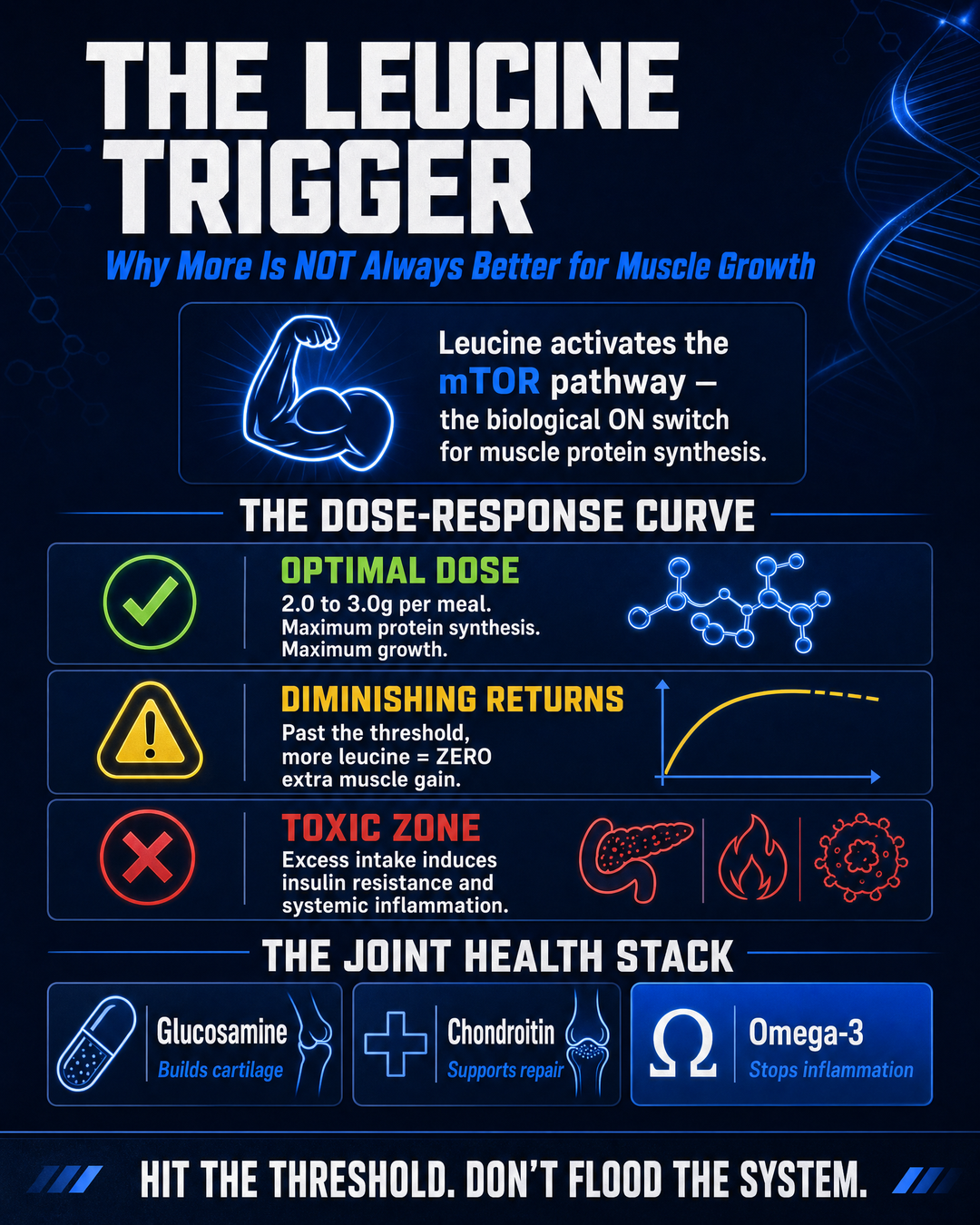
Athletes and bodybuilders are constantly searching for the perfect ergogenic aid to maximize muscle growth, increase protein synthesis, and accelerate recovery. In the realm of sports nutrition, one branched chain amino acid stands above the rest: Leucine.
Leucine is widely touted as the most prolific amino acid for protein synthesis, with claims that it has up to ten times the anabolic effect of other amino acids. It acts as a biological "trigger" that activates the mTOR pathway, signaling the body to build new muscle tissue [1] [2]. You simply cannot build muscle efficiently just by eating enough food and spiking insulin; the leucine threshold must be met.
But a critical question remains: if leucine is the ultimate trigger for muscle growth, does taking massive doses yield massive results?
The Dose Response Curve: Finding the Sweet Spot
To understand how leucine operates, we must look at controlled biological studies. A fascinating experiment conducted at Jiangnan University explored the exact dose response curve of dietary leucine. Researchers utilized juvenile blunt snout bream, a subject chosen because its feed proportions could be strictly controlled and monitored, with results that closely mirror mammalian metabolic responses [3].
The goal was to determine exactly how different levels of leucine affected weight gain, growth rate, and protein efficiency. The results were highly revealing.
The study demonstrated significant increases in growth, size, and protein retention in subjects fed optimized levels of leucine compared to those on a restricted diet [3]. However, the researchers discovered a strict biological ceiling. The optimal level of added dietary leucine was exactly 1.74 percent. Beyond this point, the anabolic effects completely flatlined [3].
More importantly, when the leucine dosage was pushed to an excessive 2.96 percent, severe adverse effects began to emerge. The subjects experienced attenuated inflammation responses and developed insulin resistance [3].
This perfectly illustrates a fundamental law of sports nutrition: there is an optimal threshold for ergogenic aids, and exceeding that threshold is not only wasteful but actively harmful. In humans, chronically elevated leucine levels driven by massive over supplementation have been linked to the pathogenesis of obesity and type 2 diabetes by inducing insulin resistance in skeletal muscle [4].
For athletes looking to maximize muscle protein synthesis safely, clinical research suggests aiming for 2.0 to 3.0 grams of leucine per meal, or roughly 20 to 45 milligrams per kilogram of body weight per day [1] [2]. Hit the threshold to pull the trigger, but do not flood the system.
Joint Health: The Synergistic Stack
While muscle growth dominates the conversation around ergogenic aids, joint health is equally critical for long term athletic performance. Heavy resistance training takes a massive toll on articular cartilage.
Many athletes turn to glucosamine to protect their joints, only to be disappointed by the results. The problem usually lies in the formulation. Taking glucosamine alone is highly inefficient.
To actually repair and protect cartilage, you must use a synergistic stack. Clinical studies demonstrate that Glucosamine must be combined with Chondroitin Sulfate [5]. These two compounds act together as the basic building blocks of cartilage and synovial fluid, stimulating the anabolic process of cartilage metabolism.
However, the true breakthrough in joint health occurs when this combination is paired with Omega 3 fatty acids. While glucosamine and chondroitin provide the building blocks for repair, Omega 3s provide a powerful anti inflammatory action that halts the catabolic destruction of the joint [5].
We can clearly see the difference in efficacy based on the supplement stack used.
Supplement Protocol: Anabolic Effect (Cartilage Repair): Anti Inflammatory Effect: Overall Efficacy for Joint Pain
Glucosamine Alone: Low: None: Poor
Glucosamine + Chondroitin: High: Low: Moderate
Glucosamine + Chondroitin + Omega 3: High: High: Excellent [5]
If you are dealing with osteoarthritis or training induced joint pain, the textbook recommendation is to run this complete synergistic stack for a trial period of two to four months.
Whether you are trying to build muscle with leucine or protect your joints with glucosamine, the lesson is the same. Success in sports nutrition does not come from blindly consuming massive quantities of isolated supplements. It comes from understanding biological thresholds and utilizing powerful, synergistic combinations.
References
[1] Mero, A. (1999). Leucine supplementation and intensive training. Sports Medicine, 27(6), 347-358. pubmed.ncbi.nlm.nih.gov/10418071
[2] Goldman, D. M., et al. (2024). Protein and Leucine Requirements for Maximal Muscular Development and Athletic Performance. Sports (Basel), 12(7), 186. pmc.ncbi.nlm.nih.gov/articles/PMC11281145
[3] Ren, M., et al. (2015). Dietary leucine level affects growth performance, whole body composition, plasma parameters and relative expression of TOR and TNF-alpha in juvenile blunt snout bream. Aquaculture, 448, 162.
[4] Melnik, B. C. (2012). Leucine signaling in the pathogenesis of type 2 diabetes and obesity. World Journal of Diabetes, 4(2), 38-46.
[5] Jerosch, J. (2011). Effects of Glucosamine and Chondroitin Sulfate on Cartilage Metabolism in OA: Outlook on Other Nutrient Partners Especially Omega-3 Fatty Acids. International Journal of Rheumatology, 2011, 969012. pmc.ncbi.nlm.nih.gov/articles/PMC3150191
More from the journal.



Get certified.
Teach kettlebell training, bodyweight exercises and dynamic tension with the BodyBell Method. The certification is approved for continuing education credits by NASM, ACE and AFAA.