Learning to Move Better After 50: Coaching, Skill, and the Power of Progression
After 50, you can still learn new physical skills, you just need better coaching and smarter progressions. Here's how the stages of motor learning apply to strength, balance, and everyday life.
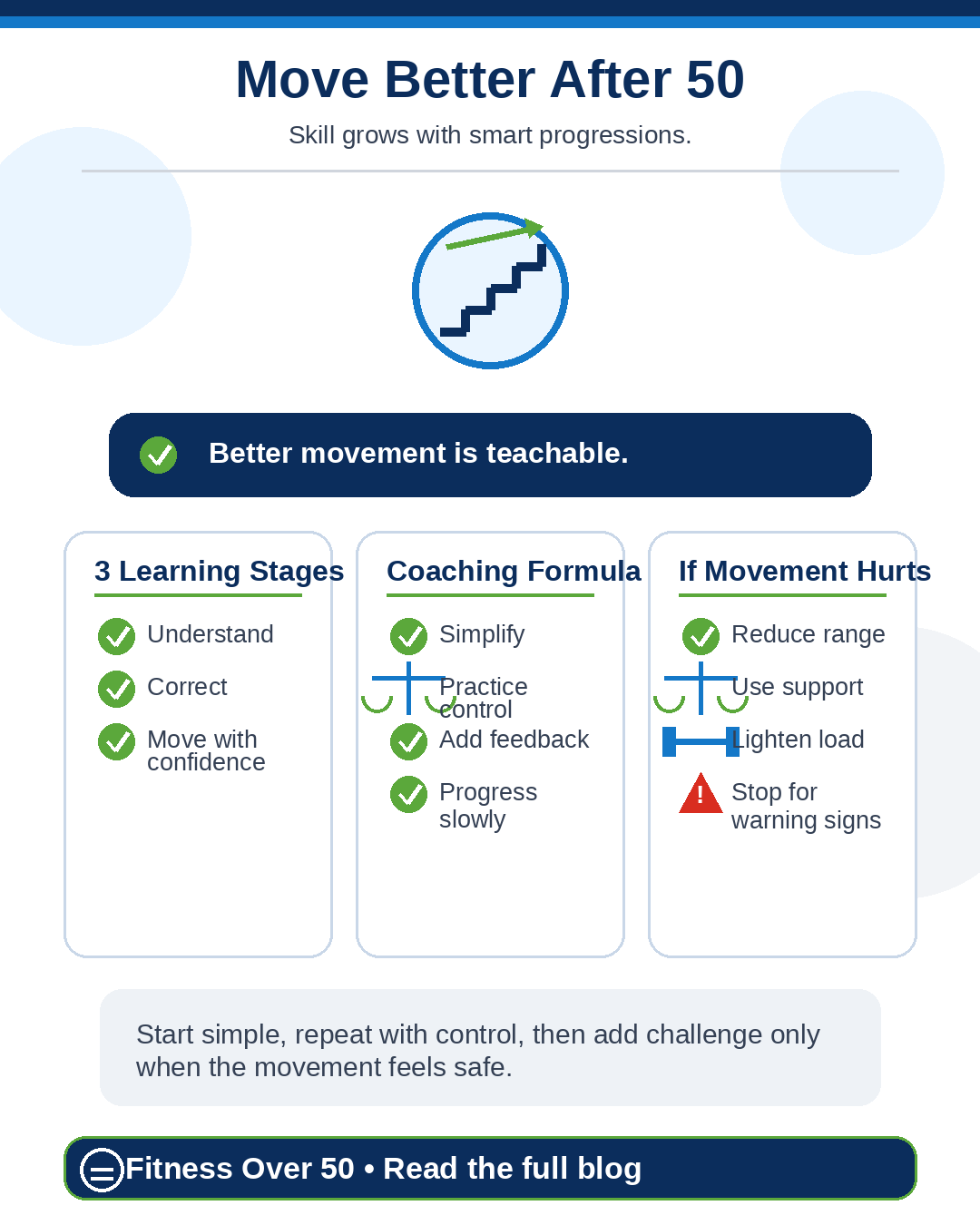
People learn movement through stages. In the early cognitive stage, the learner needs clear instruction and frequent feedback. In the associative stage, the learner begins to feel errors and make corrections. In the autonomous stage, the skill becomes more automatic and coaching becomes more refined.
Coaches also talk about degrees of freedom, reducing unnecessary movement at first so a person can learn the essential parts of a skill. Over time, the movement becomes more coordinated, more powerful, and more natural.
For adults over 50, this is a powerful message. Whether someone is learning strength training, balance work, pickleball, martial arts, yoga, golf, or simply how to move without pain, the path to success is not random. It is coached, practiced, simplified, repeated, and gradually progressed.
The Big Takeaway
After 50, you can still learn new physical skills. You may need better coaching, more patience, and smarter progressions, but your ability to improve is still there.
Motor-learning research describes skill development as a process of acquisition during practice and consolidation between practice sessions. Improvement does not only happen while you are training, it also happens as the brain and body process the practice afterward. That is one reason consistency, sleep, recovery, and repetition matter so much.
Why This Matters for the Fitness Over 50 Market
Many adults over 50 avoid exercise because they believe they are uncoordinated, too stiff, too weak, or too far behind. Often, the real problem is not the person. The problem is the progression.
A beginner should not be coached like an advanced athlete. A person with knee pain should not be rushed into deep squats. A person with balance concerns should not be asked to stand on unstable surfaces before they can control basic weight shifts. A person learning boxing, kettlebells, yoga, or strength training should not be overloaded with too many cues at once.
The CDC recommends that older adults include aerobic activity, strength training, and balance work as part of a weekly routine. That kind of program requires skill. People need to learn how to hinge, squat, step, rotate, brace, breathe, balance, and recover. Coaching makes those skills safer and more effective. Trainers, coaches and physical therapists who want to teach these skills can become certified kettlebell instructors onsite or through the online kettlebell certification.
The Three Stages of Learning Movement
In the cognitive stage, the person is trying to understand what to do. Instruction should be clear and simple, too much information creates confusion. A good cue might be, "Push the floor away," "Stand tall," "Reach toward the target," or "Move slowly and control the return." Research on attentional focus suggests cues aimed at the effect of the movement, rather than constant attention to individual body parts, support motor learning in many settings.
In the associative stage, the person starts to recognize what feels right and what feels wrong. Coaching becomes more specific. The person may need fewer cues but better cues. This is where practice quality matters.
In the autonomous stage, the movement becomes more natural. The person no longer has to think about every detail. This is where confidence grows. The goal is not perfection, it is reliable movement under real-life conditions.
What Degrees of Freedom Means in Real Life
Degrees of freedom can sound technical, but the idea is simple. When a movement is too complex, reduce the moving parts. Once the person has control, add complexity gradually.
Someone learning a squat may begin with a sit-to-stand from a chair. The chair limits the depth and provides a clear target. Once that becomes easy, lower the chair height, add a light weight, slow the lowering phase, or progress to a free-standing squat.
Someone learning a punch may first practice stance and target alignment, then add hip rotation, footwork, breathing, and speed. Someone learning balance may begin with a supported stance near a countertop before progressing to stepping patterns or direction changes.
This is not babying the client. This is intelligent coaching.
Practical Advice for Adults in Pain or Having Trouble Getting Around
If movement hurts or feels intimidating, simplify the skill. Reduce range of motion, slow the movement down, use support, lighten the load, and practice fewer repetitions with better control.
Do not judge progress only by intensity. Progress can mean standing from a chair with less hand support, walking with better posture, stepping down from a curb with more confidence, or learning to breathe during effort instead of holding tension.
If you have pain, distinguish between effort and warning signs. Muscle work, mild fatigue, and a sense of challenge can be normal. Sharp pain, joint catching, radiating symptoms, numbness, dizziness, or swelling that worsens after training should be addressed by a qualified professional.
Choose coaching that respects your current level. A good coach knows when to explain, when to demonstrate, when to cue, when to step back, and when to progress.
A Simple Skill-Learning Formula
Start with one movement pattern. Make it safe. Make it repeatable. Practice it slowly. Add feedback. Remove unnecessary movement. Build consistency. Add range of motion. Add resistance. Add speed only after control is present.
This formula works for strength training, balance, mobility, combat sports, recreational sports, and daily-life tasks. After 50, the goal is not just to learn a movement, it is to learn it well enough that it supports independence.
Better movement is teachable. Confidence is trainable. Skill can be built one smart progression at a time.
More from the journal.
Get certified.
Teach kettlebell training, bodyweight exercises and dynamic tension with the BodyBell Method. The certification is approved for continuing education credits by NASM, ACE and AFAA.