Hardware vs. Software: Why Grit Outperforms Genetic Talent in Sports
Elite athletes are rarely born; they are built. Motor learning research shows that abilities are genetic hardware, but skills are software written through practice, passion, and perseverance.
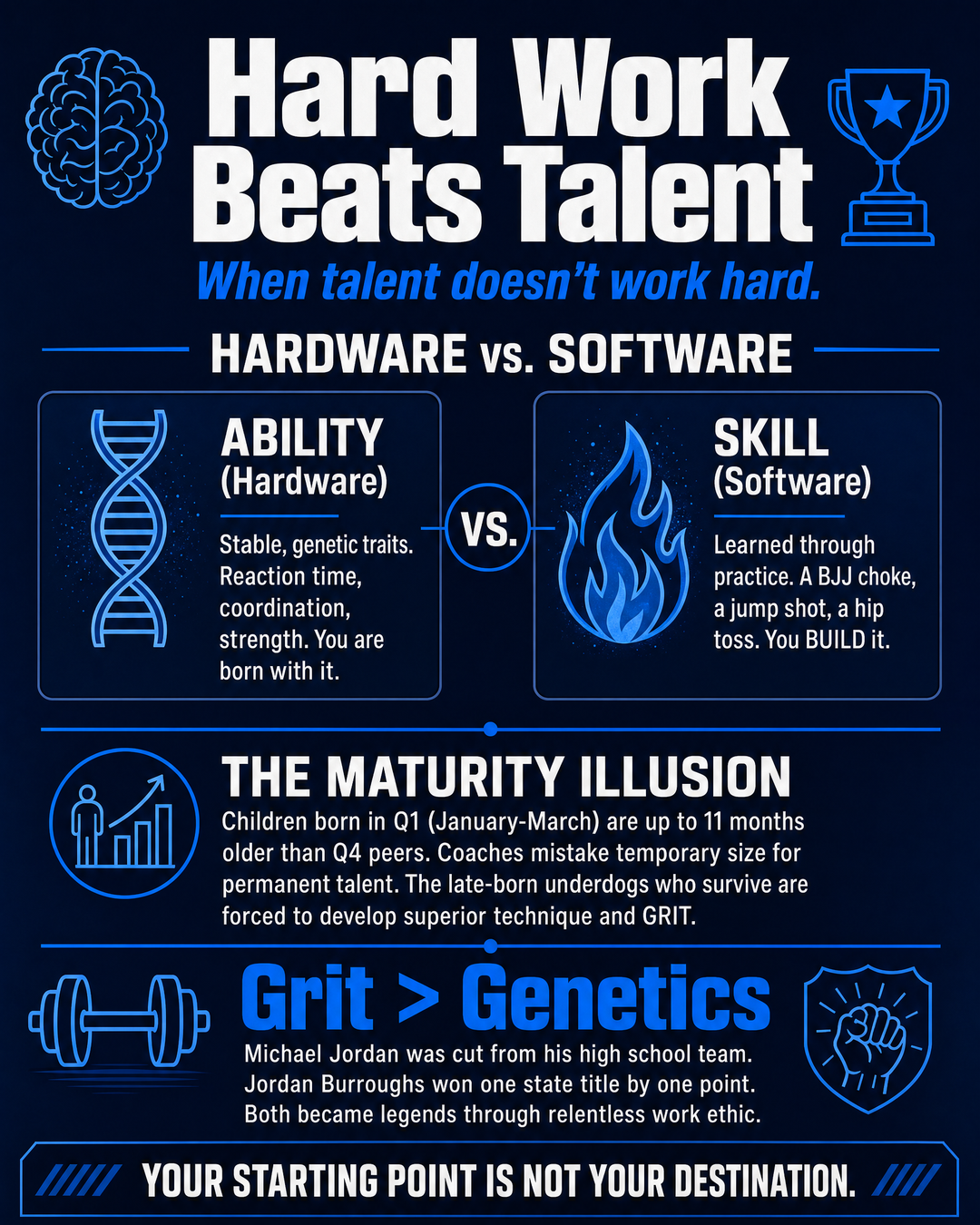
We are obsessed with natural talent. When we watch an elite athlete glide effortlessly across a field, sink a three-pointer from the logo, or execute a flawless submission hold on the grappling mat, we instinctively attribute their success to superior genetics. We tell ourselves they were simply born different.
This belief in the supremacy of natural talent is highly comforting because it provides us with an immediate excuse for our own physical limitations. If athletic greatness is entirely preprogrammed in our DNA, then we are absolved of the responsibility to strive for it.
However, when we examine the scientific literature of motor learning, a far more nuanced and empowering reality emerges. While genetic predispositions certainly exist, they represent only the raw "hardware" of the human body. The "software", the actual skills we develop through practice, combined with the psychological grit to endure hardship, is what ultimately determines our long-term success.
Hardware vs. Software: Abilities versus Skills
To understand how athletic potential translates into real-world performance, we must first master a fundamental distinction in motor learning: the difference between an ability and a skill [1].
Genetic Hardware (Abilities) ---> Stable, enduring, genetically determined traits | v Practice & Experience ---> Refines and coordinates raw abilities | v Athletic Software (Skills) ---> Learned, goal-directed movement patterns
An ability is a stable, enduring, and underlying trait that is largely genetically determined and unmodified by practice [1]. Think of abilities as the hardware of your computer. They include biological features like reaction time, multi-limb coordination, manual dexterity, visual acuity, and muscle fiber composition [1]. You are born with a certain baseline level of these traits, and while training can optimize how you use them, you cannot fundamentally rewrite your genetic hardware.
A skill, conversely, is a learned, goal-directed capability that is developed, refined, and modified through practice and experience [1]. Skills represent the software. Examples include shooting a basketball, throwing a curveball, executing a hip toss in Judo, or applying a choke hold in Brazilian Jiu-Jitsu (BJJ) [1].
While you cannot practice your way to a faster genetic reaction time, you can practice a specific skill until the movement becomes so automated that it bypasses conscious processing, making you appear to have superhuman reflexes.
The Factor Matrix of Athletic Aptitude
Every physical activity requires a unique combination of underlying motor abilities [1]. In their seminal research, motor learning theorists Richard Schmidt and Timothy Lee outlined a "Factor Matrix" of human motor abilities, demonstrating how different sports draw upon different genetic traits [1].
To illustrate this, we can compare the genetic demands of three highly distinct physical disciplines.
Motor Ability: Brazilian Jiu-Jitsu (BJJ): Olympic Marksmanship: 100m Sprinting
Control Precision: Critical (adjusting joint angles and weight on a moving opponent): High (micro-adjustments of the trigger and barrel): Low (movement is highly repetitive and linear)
Multi-Limb Coordination: Critical (simultaneously managing four limbs and core pressure): Low (body is locked in a static, stable posture): High (synchronizing arms and legs at high velocity)
Reaction Time: High (responding instantly to an opponent's transition): Low (shooter controls the timing of the shot): Critical (responding to the starting gun)
Finger Dexterity: Moderate (manipulating lapels and sleeves in Gi-based grappling): Critical (precise, isolated trigger control): Low (hands remain relaxed or closed)
Instrument Comprehension: High (understanding how to use the opponent's Gi as a weapon): Critical (understanding ballistics, windage, and sights): Low (no external instruments used)
Physical Proficiency: Critical (dynamic explosive strength and flexibility): Low (requires cardiovascular calm and static endurance): Critical (maximum rate of force development)
As the table demonstrates, an individual who lacks the steady hand required for Olympic marksmanship might still possess the perfect genetic profile for Brazilian Jiu-Jitsu [1].
Furthermore, even highly specialized cognitive abilities come into play. In Gi-based BJJ, practitioners must wear a heavy, durable cotton uniform [1]. This uniform can be grabbed, twisted, and wrapped to choke an opponent or trap their limbs. Understanding how to manipulate this fabric is a highly complex cognitive task. It requires a specialized form of "Instrument Comprehension", treating the uniform as a physical tool that alters the mechanics of the entire fight [1].
The Maturity Illusion: The Relative Age Effect
If raw genetic abilities are so important for establishing our physical baseline, then talent identification systems should be highly effective at spotting future champions at a young age. Yet, youth sports academies are notoriously terrible at predicting long-term success.
The reason for this failure is a systemic bias known as the Relative Age Effect (RAE) [2].
Youth sports leagues are organized by annual age brackets, usually using a cut-off date of January 1st or September 1st [2] [3]. A child born in January is nearly an entire year older than a teammate born in December of the same year [2].
At age seven or eight, an eleven-month age gap represents a massive difference in biological, physical, cognitive, and emotional development [2] [3].
January Birth (Q1) ---> 11 Months Older ---> Biological Maturity (Taller, Stronger, Faster) ---> Mistaken for "Talent" | v December Birth (Q4) ---> 11 Months Younger ---> Less Developed (Smaller, Slower) ---> Deemed "Untalented"
Because of this developmental gap, early-born children (those born in the first quarter of the year) are typically taller, heavier, stronger, and faster than their later-born peers [2] [3].
When youth coaches and scouts evaluate these children, they consistently make a critical error: they mistake temporary biological maturity for superior genetic talent [2] [3].
As a result, early-born children are disproportionately selected for "elite" travel teams and academy programs [2] [3]. Once selected, they receive access to the best coaches, superior training facilities, and high-quality competition [3]. This cumulative advantage compounds year after year, while the younger, less-developed children become discouraged and drop out of the sport entirely [2].
The Underdog Advantage: Reversing the RAE
Fortunately, biological maturity eventually evens out. By age seventeen or eighteen, the physical gap between a January birth and a December birth virtually disappears [2].
When this happens, a fascinating phenomenon occurs: the talent identification system often reverses, and the late-born "underdogs" begin to dominate [2].
To survive in youth sports while being physically outmatched, late-born athletes are forced to develop superior technical, tactical, and psychological skills [2]. They cannot rely on brute strength or raw speed to win, so they must learn to outsmart and out-technique their opponents [2].
Once their physical maturity catches up, these late-born athletes combine their highly refined technical skills with a hardened work ethic, frequently surpassing the early-born "prodigies" who never had to struggle in their youth [2].
The Human Element: Why Grit Outperforms Talent
This brings us to the ultimate limitation of athletic testing and genetic screening: it completely ignores the "human element." Standardized testing can measure your reaction time, your vertical jump, and your aerobic capacity, but it cannot measure your will to succeed.
In sports psychology, this quality is defined as Grit, the passion and perseverance to pursue long-term goals despite setbacks, failures, and plateaus [4] [5].
Raw Talent (Abilities) x Effort (Grit) = Skill Skill x Effort (Grit) = Achievement
Without grit, raw genetic talent is nothing more than potential energy. It is the effort applied to talent that develops real-world skills, and it is the effort applied to those skills that leads to elite achievement [4] [5].
This relationship is perfectly illustrated by the lives of two of the greatest athletes in sports history:
- Michael Jordan: Widely regarded as the greatest basketball player of all time, Jordan was famously cut from his high school varsity basketball team during his sophomore year because he was deemed too short and lacking in elite skill. Instead of quitting, Jordan used the rejection as fuel, spending hours practicing alone in the gym and developing a legendary work ethic that would eventually redefine the sport.
- Jordan Burroughs: One of the most dominant freestyle wrestlers in American history, Burroughs won only a single high school state championship in New Jersey, and he won it by a single, narrow point. He was far from a highly touted recruit. Yet, through relentless, gritty training, he went on to win two NCAA Division I national titles, an Olympic Gold medal, and six World Championships.
As the old athletic adage states: "Hard work beats talent when talent doesn't work hard."
Conclusion: Reclaiming Your Potential
We must stop viewing athletic success through the narrow lens of genetic determinism. Your genetic abilities merely establish your starting point; they do not dictate your destination.
Whether you are stepping onto a Brazilian Jiu-Jitsu mat, training for a marathon, or learning a complex physical trade, your success will not be determined by the hardware you were born with. It will be determined by the software you choose to build.
If you are a coach, a parent, or an educator, be mindful of the maturity illusion. Do not write off a late-developing child, and do not over-praise a genetically gifted youth who lacks work ethic.
And if you are an athlete striving to reach the next level, remember that the most critical variable in the equation of success is entirely within your control. Focus on deliberate practice, embrace the struggle of being physically outmatched, and cultivate the relentless grit required to endure. In the long run, your work ethic will always outlast their talent.
References
[1] Schmidt, R. A., & Lee, T. D. (2011). Motor control and learning: A behavioral emphasis (5th ed.). Champaign, IL: Human Kinetics.
[2] Green, T. (2025). Relative Age Effect. Science for Sport. https://www.scienceforsport.com/relative-age-effect/
[3] Fremont Youth Soccer Club. (2023). Relative Age Effect, What Is It? How Can We Address it? Fremont YSC Blog. https://fremontyouthsoccer.com/relative-age-effect-what-is-it-how-can-we-address-it/
[4] Elumaro, A. (2016). Personality, Grit and Sporting Achievement. Journal of Physical Education and Sports Science, 6(1), 12-21. https://www.academia.edu/70341369/Personality_Grit_and_Sporting_Achievement
[5] Hal, S. (2025). Development and validation of the Sports Grit Scale. HAL Open Science. https://hal.science/hal-04977185v1
More from the journal.


Get certified.
Teach kettlebell training, bodyweight exercises and dynamic tension with the BodyBell Method. The certification is approved for continuing education credits by NASM, ACE and AFAA.